
We hate to spring it on you like this, but if you didn’t know, Minnehaha Avenue between 46th Street S. and Lake Street is slated for reconstruction beginning in 2014.
One of the bigger decisions that needs to be made is determining the type of bike facility to install – bike lanes or a cycle track. Since the number of bicyclists is growing in our neighborhood and the city has set a goal of becoming a more bike-friendly city, we wanted to see if there were data available about what type of path bicyclists preferred and if one facility was safer than another.
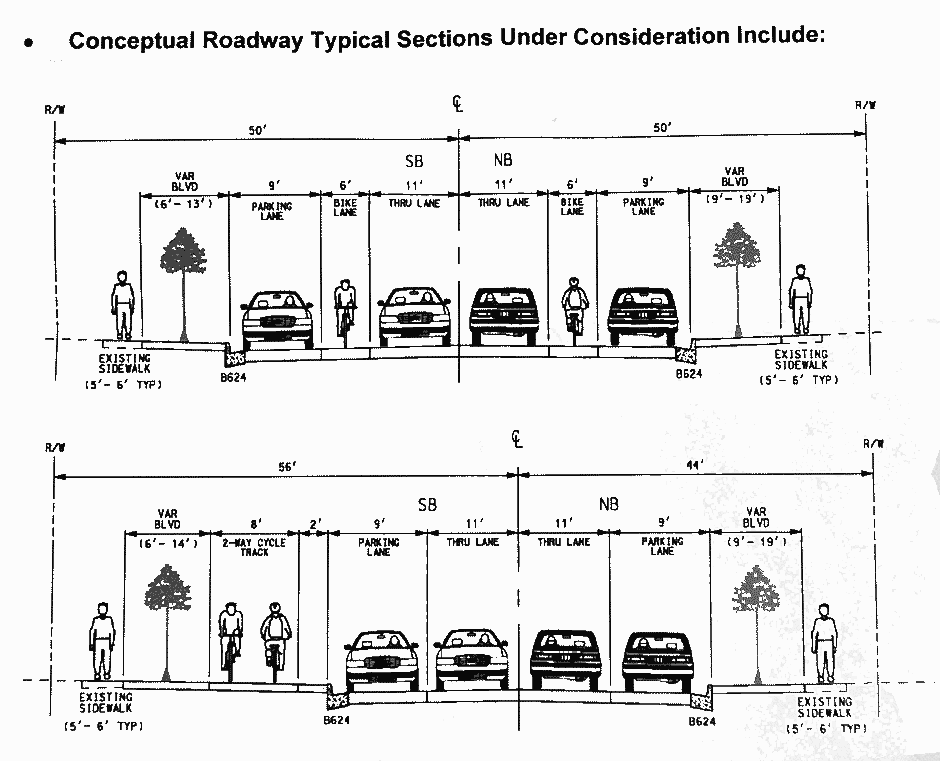
Currently there are two options for Minnehaha Ave – a bike lane in traffic, or an offset cycle track. Minneapolis has one cycle track already at 1st Ave N (downtown).
We were in luck. In a recent bicycle count done by the city, volunteers also recorded where cyclists rode – whether it was on a sidewalk or path, or on the street.
The findings are interesting. When a separate path is available (a sidewalk or bike path), 90% of bicyclists will use the path instead of riding on the street. When bicycle boulevards are available, only 4% of cyclists use the sidewalk; if shared lane markings are used, 14% use the sidewalk, and if a bike lane is available 17% use a sidewalk.
What is Safer – Cycle Track or Bike Lane?
In December, the results of a study about bike route safety and preference were published in the American Journal of Public Health. The study found that cycle tracks were the safest bike facility available and bikers preferred riding on the them – a win-win. On the opposite end of the spectrum, a major street (two or more lanes) with parked cars and a bike lane were not preferred by cyclists and were deemed considerably less safe than a cycle track.
Reducing the Fear of Cars
Increasing the safety of cyclists and reducing fear is noted to increase the number of people willing to ride a bike. In a report by Roger Geller from the Portland Office of Transportation, he wrote, “Survey after survey and poll after poll has found again and again that the number one reason people do not ride bicycles is because they are afraid to be in the roadway on a bicycle….When they say they are “afraid” it is a fear of people driving automobiles.”
Simon Blenski from Public Works echoed this sentiment, “I think one can assume that most people ride where they feel most comfortable.”
Hennepin County Plans
We asked Minnehaha Avenue reconstruction Project Manager Kristy Morter if the recent findings from the city survey would be used to determine the type of bike facility installed, and she responded that the following criteria would be used in the decision:
- Motor vehicle speeds
- Urban or rural location
- Roadway functional classification
- Average daily traffic volumes
- On-street parking
- Intersections and driveways
- Right-of-way constraints
- Vehicle turn lane configuration
- Number of traffic lanes
- Topography, grades, sight distances, and sight lines
- Traffic composition, especially volumes of large trucks
- Bus routes
- Peak-hour vehicle traffic volume
- Average daily and peak-hour bicycle traffic volume
- Bicyclist characteristics (type of bicyclists served)
- Corridor crash history
Sidewalk Riding
As a side note, the data from the Minneapolis survey also showed that the more vehicle traffic a street has, the more that bicyclists will chose to use the sidewalk. Sidewalk riding is legal in Minneapolis unless you are in a commercial district. Looking at the zoning map of Minnehaha Avenue, approximately half of the of the street is zoned commercial. If cyclists rode on the sidewalk because they felt unsafe on the street, would that affect the walkability of Minnehaha Ave?
Providing Feedback
Hennepin County will be holding a public open house in the future, and will be taking comments. When we hear the dates, we will let you know.
In the meantime, what do you think? Do you have a preference between cycle track or bike lane for Minnehaha Ave? Are there other issues you are concerned about?







Prefer the cycle tract as it is separated from auto traffic.
I absolutely prefer the cycle track. I recently moved to Longfellow from Seward and want to bike to the co-op, Zipps, and other places on Franklin Ave–I would feel MUCH safer riding on a cycle track separated from traffic. Also, thanks for pointing out the rules about biking on sidewalks. I’ve always assumed it was illegal to bike on sidewalks, but it’s good to know that that’s only true in commercial districts.
Cycle track, please
Cycle track. A personal experience-my niece was seriously injured when she crashed into someone who had opened a car door just after parking their vehicle. The bike lane next to the driver’s door of parked cars increases the likelihood for a repeat of this circumstance.
Are they not considering one-way cycle tracks on each side?
I tend to prefer cycle tracks, but I hope they come with raised crossings at intersections with side streets. Visibility is a serious weakness to cycle tracks but it’s pretty well mitigated with raised crossings.
I prefer the cycle track, but am concerned about the narrow lanes the snow will create for cars in the winter. The bike lanes are nice in the winter when snow makes the car lanes smaller, but that will not be there if the bike lanes aren’t there.
As a driver, I am fearful FOR the bicyclists who are traveling on the roadway. If their bike tire blew out, they could be seriously hurt if they crashed into or fell against my moving vehicle. Even though drivers might be traveling at the posted speed (a criteria stated by Kristy Morter),it is dangerous for both the bicyclist & (vehicle) driver.
The bike lanes that have been set up in recent years (e.g. on Franklin near and crossing over the river, on Riverside near Franklin, on Minnehaha near Rainbow Foods and Dominos Pizza, etc) just seem crazy. I won’t use them. Many drivers don’t understand them (including sometimes me when I’m driving) – especially near intersections with turn lanes – and drivers need to cross them to turn at intersections. Cyclists are in precarious positions between traffic and parked cars, and between the main traffic lanes and the the turn lanes. Just drawing these lanes on the street and saying they are for bicycles does not do much to make the situation better/safer for cyclists.
Dedicated bike tracks that are separated from traffic, and that don’t put bicycles between traffic and parked cars, are MUCH better. The bike paths along the West River Parkway would be an example of this sort of thing.
Even these dedicated bike tracks are not perfect though, particularly when you have the “power riders” who refuse to slow down as they approach others, and who practice unsafe high speed passing (as they overtake slower bicycles) that risks head-on collisions between cyclists. This two-way bicycle traffic on narrow (and sometimes even not so narrow) bike paths can be very hazardous, though I will say that it is not near so terrifying as being out between traffic and parked cars, or between traffic and turn lanes.
I guess I’d like to know whether the people making decisions about these matters in the city are bicyclists themselves? Do they have loved ones who commute by bicycle? Do they have kids who commute by bicycle? I find it hard to imagine that many of them are cyclists (or that they have close family members who are), or they would not create some of the profound safety hazards that have been created with some of the recent (last few years) bike lanes on busy streets I mentioned above.
The right thing for our community, and for the world, is to get more people riding bicycles and less people driving. But this is simply not going to happen the way it could, or should, unless we build our communities and roads in such a way that the average person can get on a bicycle and get where they need to go without feeling like they are putting their lives at risk by doing so.
Incidentally…..
I also think many cyclists need to show greater common sense.
- I am frequently bewildered by why some cyclists choose to ride on busy streets when there are often/usually quiet, low traffic side streets running parallel to the busy street just one block away. I commute by bicycle a lot, but only on those quiet side streets.
- I am frequently bewildered by bicyclists who ride at night (often on busy streets) with no lights (or with really feeble lights) – don’t they realize that they are often virtually invisible to drivers?! And when driving at night it is not uncommon to encounter bicyclists who don’t even have reflectors (or whose reflectors are all but invisible to drivers).
Hi Bill,
Thanks for your comment. The project is being run by Hennepin County. The project manager is Kristy Morter (kristy.morter at co.hennepin.mn.us) and my understanding is that she is the primary contact for the project at this point.
Hennepin County is collaborating with Minneapolis City Engineer Jeff Handeland (jeff.handeland at ci.minneapolis.mn.us).
Hennepin County will hold a public meeting, and we will be sure to post the dates and times when they are scheduled.
Another good contact would be Council Member Sandy Colvin Roy. The design needs to be approved by City Council, so if you have comments, I would send them her way. She is at sandra.colvin.roy at minneapolismn.gov.
We’ll work on staying on top of the reconstruction and design decisions as the project progresses and posting information here.
Rebekah